

Search for the best auto like tools for Instagram and Facebook. You get two different products. One likes posts from your account. The other sends likes to a public link. The first needs your login. The second does not. That gap decides your risk. This guide maps both, shows what Meta allows, and explains where an auto liker fits in 2026.
You will also get a short test. Run it before you connect any tool to your account.
Two products share one name
Most list posts mix them up. That is why the advice feels confusing.
- Account bots like and follow from your profile. They need a login, a cookie, or a browser extension.
- Request dashboards send likes to one public post. You paste a link. You keep your password.
One touches your account. The other touches a link. Treat them as different tools.
What does Meta allow in 2026?
Meta publishes a clear set of API actions. They cover posting, comments, and messages. They leave out likes and follows for outside apps.
That detail matters. A tool that auto-likes from your account uses an unofficial method. Meta can block it, limit it, or remove the result.
Meta also warns against sites that trade free likes for login details. Its help page lists the risks. They include spam, data exposure, and removed likes.
Why the API stops at messages
Meta built the API for business messaging. A comment can start a private reply. A story reply can open a chat. A like on a stranger's post has no such path.
So the honest answer is simple. No outside app can like posts for you through the official API.

The four types of auto like tools
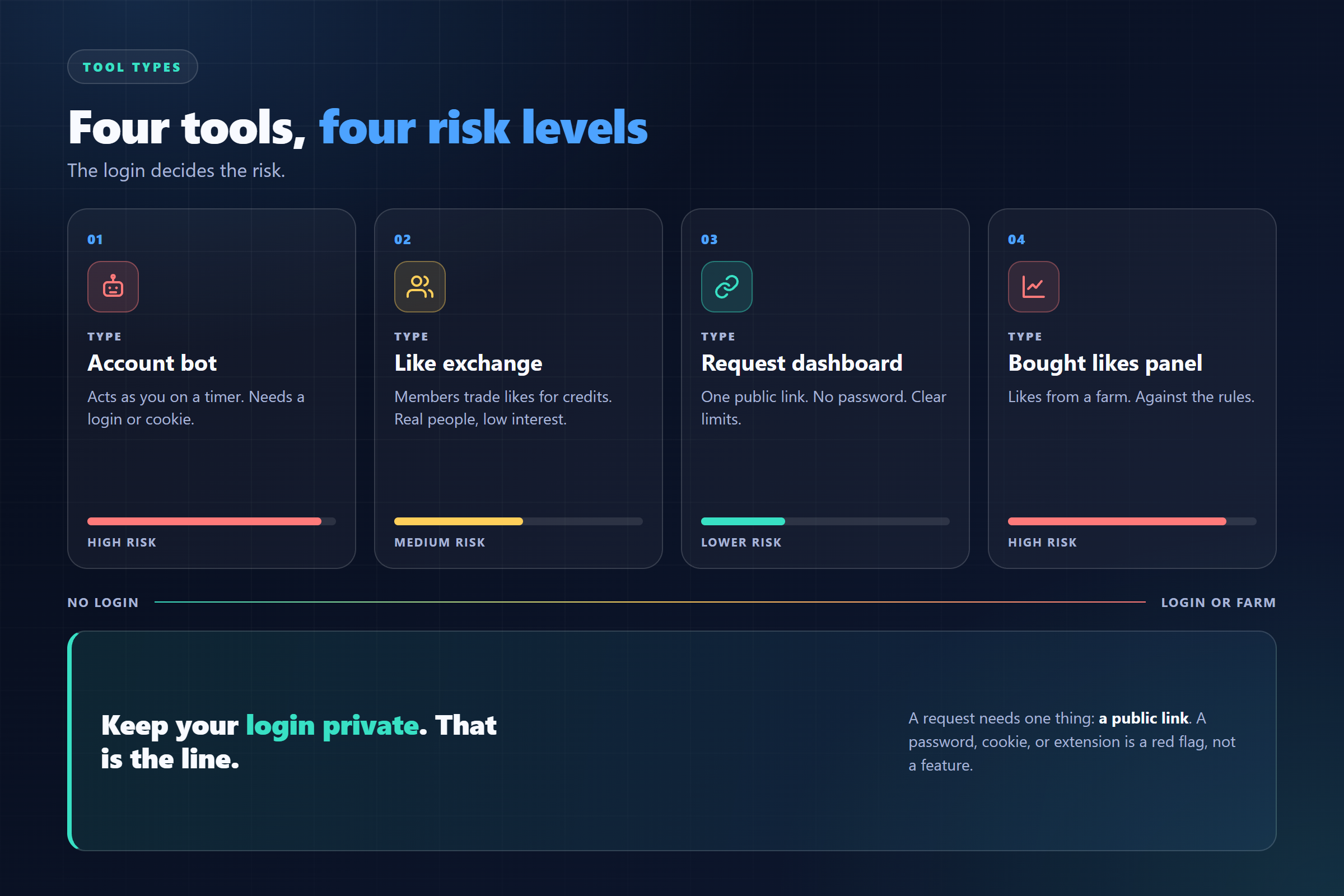
Here is the full map. Each type trades something different.
| Type | How it works | Login | Risk |
|---|---|---|---|
| Account bot | Acts as you on a timer. | Yes. | High. |
| Like exchange | Members trade likes for credits. | No. Slow. | Medium. |
| Request dashboard | Sends likes to a public link. | No. | Lower. |
| Bought likes panel | Sends likes from a farm. | No. Against rules. | High. |
1. Account bots and extensions
These tools log in as you. Some use a browser extension. Some store a session cookie. They like and follow on a timer. Pacing settings change the speed, not the method.
2. Like exchanges
Members earn credits by liking other Pages. They spend credits on their own. The people are real. Their interest is often low. Delivery can take days.
3. Request dashboards
You paste one public link. The dashboard sends a set number of reactions. You never share a password. AutoLikerLive works this way. The model limits risk. It cannot promise perfect results.
4. Bought likes and panels
A panel sends likes from a pool of accounts. The likes may look real at first. Meta can remove them later. Brand deals and audits can also expose the gap.
Instagram vs Facebook: what changes
Instagram leans on Reels, comments, and DMs. Facebook leans on Pages, Groups, and messages.
For Instagram, a public post link is enough for a reaction request. For Facebook, a Page post or a Page link works.
Neither platform offers a like button in its public API. The rule is the same on both.
A 9-point safety check
Run this list before you connect anything.
- Does the tool ask for your password? Leave.
- Does it ask for a login code, token, or cookie? Leave.
- Does it explain how it sends likes? If no, pause.
- Does it show a company name and support contact?
- Does it promise thousands of likes in minutes? Treat that as a warning.
- Does it ask you to like unrelated Pages first? That points to an exchange.
- Does it let you test one small public link?
- Does it list clear limits and refund terms?
- Does it claim "Meta-approved" status? No like seller has Meta's backing.
Red flags to avoid
Some offers are traps. Watch for these signs.
- A fake Facebook or Instagram login page.
- A browser extension that wants to act as you.
- A request for your recovery email or phone.
- A promise of "undetectable" likes.
- A price too low to cover real work.
How AutoLikerLive handles Instagram and Facebook
AutoLikerLive uses the request model. You open the dashboard. You pick a service. You paste a public link. You set the amount. The system processes the order.
A public link needs no password. Limits apply. Results can vary.
AutoLikerLive is independent. Meta has no role in it. Use it for a short lift in social proof. Pair it with real content.
Start small. One public post is enough for a first test. Watch the result before you scale.
What to use for real growth
Likes can start a Page. They cannot build a community. Use these steps.
- Post useful content on a steady schedule.
- Reply to comments and messages.
- Invite people who know your business.
- Run a small Meta boost on your best post.
- Track saves, shares, and profile visits.
For more on free like offers, read our guide to Like FB Gratis and our free Facebook likes safety guide.
FAQ
Are auto like tools safe?
It depends on the type. A password-based bot is a security risk. A public-link request needs no login. Meta may still remove artificial likes.
Can Meta detect auto likes?
Meta scores behavior, not brand names. Bulk actions and flat timing look odd. That can lead to limits or removed likes.
Does Instagram allow auto likes?
Instagram gives outside apps no like action. Tools that auto-like from your account use unofficial methods. That is why they carry risk.
What is the best auto liker for Facebook?
Pick one that never asks for your password. Check its method, limits, and support. Test one public link first. AutoLikerLive is one option.
Do bought likes help reach?
Not by themselves. Reach depends on content and audience. A big count with no comments can look empty.
Next step
Ready to test the request model? Open the AutoLikerLive auto liker. Paste one public link. Start with a small order.
Then check your insights for a week. Keep what works. Drop what does not.
Leave a Reply